


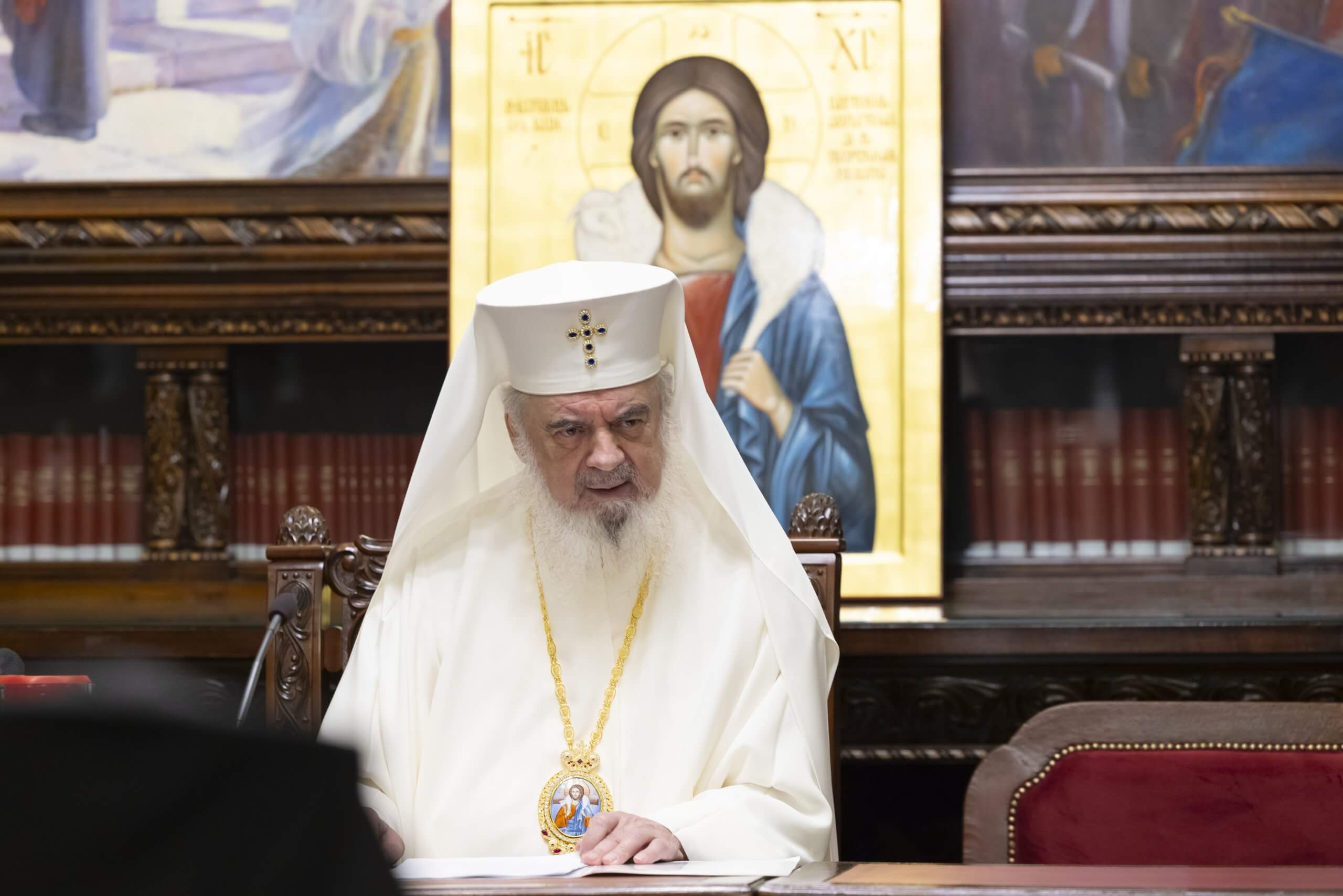
His title is: “His Beatitude (N), Archbishop of Bucharest, Metropolitan of Muntenia and Dobrudja, Lieutenant of the throne of Caesarea Cappadocia and Patriarch of the Romanian Orthodox Church” or “Patriarch of Romania”.
In accordance with the Holy Canons, the pan-Orthodox tradition and the practice of the Romanian Orthodox Church, the Patriarch of Romania is mentioned (referred to liturgical services) by the metropolitans, and the latter are mentioned by the suffragan hierarchs, while the archbishops and bishops are mentioned by the priests who serve them. The Patriarch of Romania wears the following distinctive insignia: a cross and two encolpions, white robes: inner and outer cassock, koukoulion and a kamilavka with a cross (Article 25 of the Statute).
Responsibilities
The Patriarch of Romania exercises the rights and fulfils the duties provided for by the Holy Canons, by the present Statute and by the Church Regulations. In the exercise of his rights and duties, the Patriarch of Romania issues: patriarchal tomes, patriarchal grammata, patriarchal acts, patriarchal decisions and dispositions, acts granting ecclesiastical orders, distinctions and ranks, provided for by the present Statute and the Church Regulations (Art. 25 of the Statute).
The Patriarch of the Romanian Orthodox Church has the following attributions:
- He convenes and presides over the central deliberative and executive ecclesiastical deliberative and executive bodies and sees to the fulfilment of their decisions;
- convenes the Holy Synod within a maximum of three days in cases of emergency and force majeure;
- when it finds that the application of a decision of the Holy Synod is no longer favourable to ecclesiastical life, it convenes the Permanent Synod in an extraordinary session to formulate and propose to the Holy Synod, for discussion and approval, a new decision amending or supplementing the previous decision;
- order the necessary measures, in accordance with the decision of the Holy Synod, for the preparation and consecration of the Great Myrrh at the Romanian Patriarchate;
- represents the Romanian Patriarchate in relations with the central and local public authorities, in legal proceedings and vis-à-vis third parties, personally or through authorized delegates;
- shall represent the Romanian Orthodox Church in relations with the other sister Orthodox Churches, in person or through authorized delegates;
- represents the Romanian Orthodox Church, personally or through delegates, in relations with other Christian Churches, inter-Christian organizations, religious and inter-religious organizations, in the country and abroad;
- addresses pastoral letters for the entire Romanian Orthodox Church, with the consent of the Holy Synod or Permanent Synod;
- conducts canonical (statutory) visits to the dioceses of the Romanian Orthodox Church, at the invitation of their hierarchs;
- conducts irenic visits to the other Orthodox Churches and addresses irenic letters to their Primates, in order to maintain the unity of Orthodoxy and to promote fraternal communion;
- conducts official visits to other Christian Churches, Christian, religious and civil organizations for the benefit of the Romanian Orthodox Church;
- sees to the fulfilment of the statutory dispositions for filling vacant dioceses;
- presides over the Holy Synod for the election of Romanian Orthodox metropolitans in the country and abroad;
- ordains together with other hierarchs and enthrones the metropolitans;
- issues the patriarchal tomos for the proclamation of the elevation in rank of a diocese, based on the approval of the Holy Synod;
- issues the patriarchal grammata for the enthronement of metropolitans and diocesan bishops from outside the borders of the country who are under the direct authority of the Romanian Patriarchate;
- issues the patriarchal grammata for the granting of honorary ranks to hierarchs (honorary archbishop or honorary metropolitan);
- appoints deputy metropolitans in the event of vacancies of metropolitan sees;
- fraternally advises the hierarchs of the Romanian Orthodox dioceses in the country and abroad and reconciles possible disagreements between them;
- refers to the Permanent Synod, in a written address, the misconduct of the metropolitans, hierarchs under the direct authority of the Romanian Patriarchate and patriarchal assistant-bishops, requesting the investigation of the said referral with a view to bringing to the trial of the Prime Archiepiscopal Consistory;
- receives the motivated appeal of a hierarch sanctioned by a decision of the Primary Archiepiscopal Consistory approved by the Permanent Synod and forwards it to the Final Archiepiscopal Consistory for judgment;
- in consultation with the Permanent Synod, proposes to the Holy Synod candidates for Patriarchal Assistant-Bishop and presides over their election;
- in consultation with the Diocesan Assembly of the vacant diocese, proposes to the Permanent Synod 2 (two) candidates for the office of Diocesan Bishop of a diocese under the direct authority of the Romanian Patriarchate;
- exercises the right of appeal and the right of devolution in the metropolises and dioceses under the direct authority of the Romanian Patriarchate for the restoration of canonical and administrative order;
- appoints, sanctions and revokes, in a meeting of the Permanent National Ecclesiastical Council, the managerial personnel, as well as other categories of clerical and non-clerical personnel of the Chancery of the Holy Synod, the Patriarchal Administration, the Biblical and Orthodox Mission Institute, other central ecclesiastical institutions with missionary purposes, as well as the personnel of ecclesiastical units within the country and of representations, communities and ecclesiastical units outside the country’s borders, under the direct authority of the Romanian Patriarchate;
- convenes and chairs the meetings of the Committee on Church Painting, personally or through a delegate, approves, amends or rejects the decisions of the Committee, with the aim of promoting authentic Orthodox painting and supporting the ecclesiastical units;
- appoints the members of the Committee for Church Painting, and in case of indiscipline or incompetence, sanctions and removes them;
- issues, suspends or cancels the certificates of church painter/restorer at a meeting of the Church Painting Committee if they do not meet the requirements of the Church Painting Committee;
- approves, modifies or rejects the decisions of the Committee for Church Paintings in cases of appeal or arbitration;
- approves as a matter of urgency church painting projects/designs and orders measures to carry out the legal procedures and to achieve the approved objectives;
- annually approves the list of authorized ecclesiastical painters and restorers in the Romanian Patriarchate, at the proposal of the Committee for Ecclesiastical Painting;
- delegates one or more members of the Committee for Ecclesiastical Painting to investigate complaints received from the dioceses on any improperly executed works of ecclesiastical painting;
- issues, suspends or cancels, at a meeting of the Committee for Ecclesiastical Painting, authorizations in various fields of ecclesiastical art;
- sanctions authorized ecclesiastical painters or restorers in the Romanian Patriarchate, upon the proposal of the Committee for Ecclesiastical Painting;
- approves the format of the documents used by the Commission for Church Painting, upon its proposal;
- by Patriarchal Decision, dissolves the Diocesan Assemblies in order to organize new elections and confirms the new Diocesan Assemblies;
- in the case of actions inimical to the Church on the part of the Diocesan Assembly, at the request of the local hierarch or his substitute, the Patriarch of Romania, by a Patriarchal Decision, dissolves that Diocesan Assembly in order to organize new elections;
- in exceptional cases and for justified reasons, in accordance with Orthodox tradition and Romanian custom, he may establish strauropegions in the interest of the Church, with the prior consent of the local hierarch and with the approval of the Holy Synod, which he organizes and administers through his delegates;
- awards patriarchal distinctions to clerics and laymen of the Romanian Orthodox Church, as well as to personalities in the country and abroad who support the activities of the Romanian Patriarchate;
- approves, at the request of a foreign Orthodox hierarch, the canonical charter of exit from the Romanian Orthodox Church of a lay or monastic cleric, which has been issued by his hierarch;
- approves, at the request of a foreign Orthodox hierarch, the transfer of monks to Mount Athos or to monasteries of other autocephalous Orthodox Churches, after having obtained the prior consent of their hierarch;
- approves the ordination of graduates of Orthodox theological educational institutions in Romania to communities of Romanian Orthodox dioceses outside the country, after having obtained the written consent of the hierarch who granted the blessing for their studies and of the Romanian hierarch outside the borders of the country who is requesting the ordination of the graduate in question;
- approves the transfer of the graduates of Romanian Orthodox theological educational institutions to another autocephalous Orthodox Church for ordination, after obtaining the prior consent of the Romanian Orthodox hierarch who granted the blessing (written approval) for the theological studies and consultation with the Romanian Orthodox hierarch of the region concerned (Europe, America and Australia);
- grants the blessing (written approval) for Romanian Orthodox theologians wishing to study abroad;
- approves the bringing of the relics of saints from outside the country, for pilgrimage or as a gift, into the Romanian Orthodox Church and informs the Holy Synod about it;
- approves requests addressed to Romanian Orthodox dioceses for pilgrimages with relics of saints from outside Romania and informs the Holy Synod about them;
- grants the blessing (written approval) for the transfer of relics from one Romanian Orthodox diocese to another, for pilgrimage or as a gift, and informs the Holy Synod about it;
- approves the taking of rest leave for metropolitans of the country and abroad, for hierarchs who are under his direct authority, as well as for the personnel employed in the central ecclesiastical institutions and in ecclesiastical units which are under his direct authority;
- exercises other duties prescribed by the Holy Canons, the present Statute, the Church Regulations and those entrusted by the Holy Synod (Article 26 of the Statute);
- The Patriarch of Romania has at his disposal the Patriarch’s Office, coordinated by a Patriarchal Vicar (Assistant-Bishop), with the appropriate staff and related services: secretariat, registry, archives, library, etc. (Art. 27 of the Statute).
