

The Holy Synod of the Romanian Orthodox Church proclaimed 2026 as the Solemn Year of Christian Family Pastoral Care and the Commemorative Year of the Holy Women in the Calendar (Myrrh-bearers, Martyrs, Nuns, Wives, and Mothers), thus recognizing the fundamental role that the family and women play in shaping and preserving Christian identity, as well as in passing on the Christian faith from one generation to the next.
In the current era, when the institution of the family faces multiple challenges and the role of women in the Church and in society requires deeper understanding and appreciation, it is essential to rediscover and value to a greater extent the Orthodox Tradition, which sees the family as the fundamental nucleus of the Christian community and Christian women as models of faith, sacrificial love, and piety.
The Church has a duty to support and strengthen the Christian family by offering pastoral guidance and spiritual support for all stages of family life: preparing young people for marriage, Christian education of children, overcoming difficulties, and strengthening bonds of love among family members. The Christian family is not only a social unit, but also a small church (“for also the home is a small church“[1]), according to Saint John Chrysostom, in which the Orthodox faith is lived and transmitted in a lively and natural way. Holy Scripture describes God’s relationship with the world as one of intimacy, like a sacrament of marriage and a family (cf. Ephesians 5:21-33). The Church is the place where, through the purifying work of the Holy Spirit on the soul of the humble man, brotherly love is lived in God the Son who became Man and the fatherly love of God the Father, whom our Lord Jesus Christ taught us to call thus: “Our Father, Who are in heaven.” The Church is, therefore, the Family of the Holy Trinity’s love for mankind, and the Christian family has rightly been called the “domestic Church” (“Ecclesia domestica“).
Considering that the social transformations of our era have led to a shift from the traditional extended family, which included at least three generations, to the nuclear family, with the risk of a certain isolation from the wisdom of previous generations, the Church is called to rediscover and promote the bonds between children, parents, and grandparents, as well as perennial values of the family.
Holy Scripture and Holy Tradition show us the special value of women in the life of the Church and in understanding the Gospel of Christ. The Church has promoted the dignity of women, especially by venerating Mother of Jesus Christ as the ideal of femininity, bearer of God and holiness, calling her the Most Holy (Panagia). She is both Virgin and Mother, icon of the Church sanctified by the grace of the Holy Trinity, of the Christ-bearing humanity, and of the humble, merciful, and sacrificial love.
At the same time, Holy Scripture presents us with numerous examples of women who were witnesses and bearers of this humble and merciful love. The Holy Myrrh-bearing Women, together with the Mother of God, have shown unwavering faith and exemplary devotion to the Lord Jesus Christ. They were the first to receive the great news of Christ’s Resurrection and the first to convey the truth of His Resurrection to His disciples. In this regard, Saint John Chrysostom draws our attention to the following: “Look how the Lord, through women, brings good news to his disciples! The Lord – as I have often said – honors the most despised race, the female race, gives them good hope, and heals their pain“[2].
Throughout Christian history, holy women have shown that the path to holiness does not depend on belonging to a particular social class, but on opening one’s heart to God and cooperating with divine grace – the holy martyrs who confessed their faith at the cost of their lives, the holy women who chose the path of asceticism, of fasting, of repentance, and of unceasing prayer, but also the holy Christian wives and mothers who enriched the Orthodox tradition through the example of a Christian life lived in the midst of their families, of the ecclesial community, and of society.
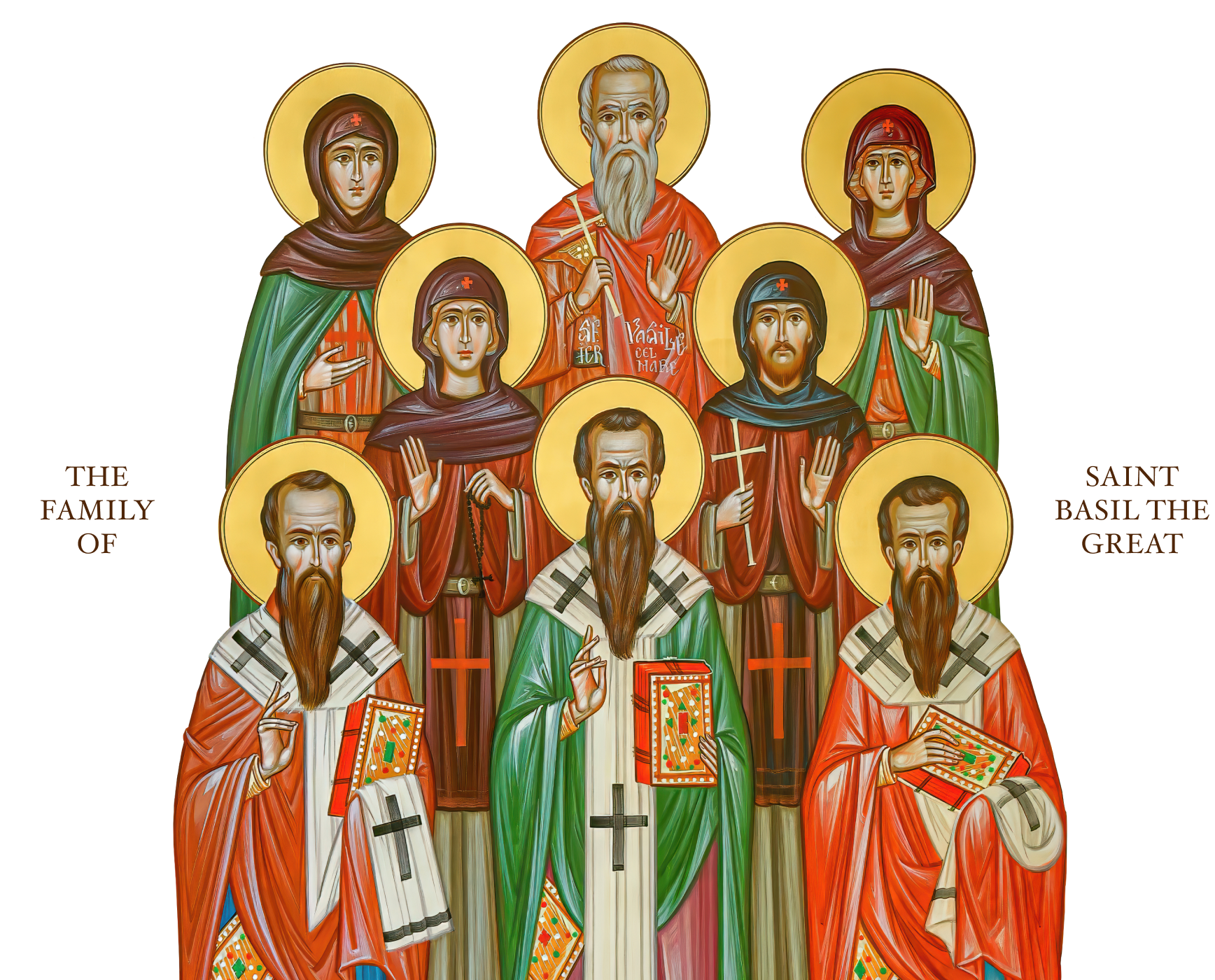
The Christian family finds models of holy living in numerous holy families throughout the history of the Orthodox Church. For example, in the fourth century, the family of Saint Basil the Great provides us with a remarkable example of how holiness begets holiness: parents Basil and Emilia, grandmother Macrina the Elder, and five of their children—Saint Basil the Great, Saint Gregory of Nyssa, Saint Peter of Sebaste, Saint Naukratios (a great hermit and wonder worker in the Sinai desert), and Saint Macrina the Younger—all eight became saints in the Church calendar, showing that Christian education and living the evangelical virtues in the family can bear the fruits of holiness for all generations. Also, later, in the 14th century, the family of Saint Gregory Palamas, where the parents Constantine and Kalloni and their five children – Gregory, Theodosius, Macarius, Epicharis, and Theodota – were all seven canonized by the Church, shows us that holiness can flourish both in Christian families and in monastic life, through love of God and love of one’s neighbor. In these concrete models of Christian life, the family becomes the place where Christian virtues are learned and practiced: fervent prayer, humble and merciful love, long enduring patience, forgiveness, and helping those in need.
We are also delighted to mention that in 2025, the Holy Synod of the Romanian Orthodox Church canonized sixteen women of holy life, whose canonization will be proclaimed in 2026. Among them are not only mothers whose children became saints, such as Saint Filofteia of Pasărea Monastery (mid-18th century – 1833, mother of Saint Calinic of Cernica), Saint Filotimia of Râmeț (1896-1989, mother of Saint Dometie the Merciful), Saint Olimpia of Fărcașa (1880-1967, mother of the Elder Petroniu of Prodromu) and Saint Anastasia Șaguna (1785-1836, mother of Saint Hierarch Andrei Șaguna), but also pious women who chose the path of monasticism, such as Saint Mavra of Ceahlău (17th-18th centuries), Saint Nazaria of Văratic (1697-1814), Saint Olimpiada of Văratic (1757-1842), Saint Elisabeta (Safta) Brâncoveanu (1776-1857), Saint Antonina of Tismana (1923-2011), Saint Matrona of Hurezi (1852-1935) and Saint Elisabeta of Pasărea (1970-2014, a hermit who lived a harsh life on Mount Giumalău in Bucovina) or women who, even though they lived in the world, lived a holy life, such as Saint Magdalene of Mălainița (1895-1962) from Serbia. Among these new women saints are also confessors of the faith, such as Saint Confessor Blondina of Iași (1906-1971, a teacher deported for fifteen years to Siberia for her faith) and Saint Martyr Evloghia of Samurcășești (1908-1949, a missionary and nun who suffered for Christ during the communist persecutions), as well as the wives of princes, who sanctified their own lives in their families or in monasteries: Saint Maria Brâncoveanu (1661-1729, wife of Saint Voivode Martyr Constantin Brâncoveanu, mother of eleven children: four sons and seven daughters) and Saint Platonida of Argeș (1487-1554, formerly Despina Milița, wife of Saint Voivode Neagoe Basarab). These new women saints in the calendar show us that the Romanian Orthodox Church has always been blessed with faithful and pious women who fought the good fight and accomplished their earthly journey (cf. 2 Timothy 4:7) in many forms of ministry:mothers whose children became saints, women martyrs who defended the faith with their blood, women who chose the monastic life, women who endured persecution for the name of Christ, and wives of princes or rulers who supported Church and the Romanian people.
One of the great contemporary elders, Saint Sophrony of Athos, testified from experience that “the giant body of humanity is made up of cells, one of which is family; as long as the cells are healthy, the whole body[3] is healthy too”. Unfortunately, today we observe a spiritual crisis in the institution of the family, manifested by an increase in the number of divorces, a weakening of the bonds between generations, and a diminishing role of the family in the religious education of children. Many families face economic, social, and spiritual difficulties that can affect their cohesion and stability. Therefore, the Church is called to intensify its pastoral efforts to strengthen the Christian family, to develop counseling and support programs for families in difficulty, to provide adequate religious education for children, and to promote the values of the Christian confessing family.
Through her strong faith, her humble and merciful love for her fellow human beings, her practical wisdom, and her spiritual strength, the pious woman has been and remains a great support to the Christian community. The Church is called to make use of the gifts and talents specific to women of faith and to support them in fulfilling their Christian vocation, whether within the family, in monastic life, or in the educational, cultural, and philanthropic service of the ecclesial community and of society.
In this regard, the Romanian Orthodox Church will continue and intensify its activities of supporting the family and of promoting the role of women in society. Through family counseling centers, marriage preparation programs, social assistance activities, and the work of women’s organizations, the Romanian Patriarchate will continue to offer practical support for strengthening Christian families and developing a clear awareness of the importance of women in the life of the Church.
Currently, the Romanian Patriarchate operates 68 social assistance offices, 148 day centres for children, 61 residential centres for children, 108 centres providing information, counselling, support and community services, 23 protected housing facilities, 19 emergency centres and many other women’s organisations, including at the parish level, all dedicated to supporting Christian families and promoting Christian family values. Certainly, the recent canonization of sixteen women who lived holy lives, many of whom were exemplary mothers and educators of saints, confirms the special importance of faithful women in the life of our Church and of the Romanian people.
By proclaiming this commemorative and celebratory year (2026), the Romanian Orthodox Church wishes to promote the growth of Christian life within the family, love between husband and wife, between children and parents, and love for the Church and for one’s nation, for the glory of the Holy Trinity and for the good of the nowadays society.
† Daniel
Patriarch of the Romanian Orthodox Church
Cuvântul înainte al Preafericitului Părinte Daniel, Patriarhul Bisericii Ortodoxe Române, la Calendarul creștin-ortodox 2026.
[1] „Καὶ ἡ οἰκία γὰρ Ἐκκλησία ἐστὶ μικρά”; Saint John Chrisostom, Ὑπόμνημα εἰς τὴν πρὸς Ἐφεσίους ἐπιστολήν (Commentary on the Epistle to Ephesians), XX, 6, in: PG 62, 143.
[2] Sfântul Ioan Gură de Aur, Omilii la Matei, LXXXIX, III, (Părinți și Scriitori Bisericești 23), translation, introduction, indices and notes by Rev. Fr. D. Fecioru, București, Ed. Institutului Biblic și de Misiune al Bisericii Ortodoxe Române, p. 995.
[3] Arhimandritul Sofronie, Taina vieții creștine, translation by Hieromonk Rafail Noica, Alba Iulia, Ed. Reîntregirea, 2014, p. 122.
Site-ul patriarhia.ro utilizează cookie-uri funcționale esențiale pentru buna funcționare a platformei, precum și cookie-uri statistice care ajută la analiza traficului și îmbunătățirea experienței de navigare.
